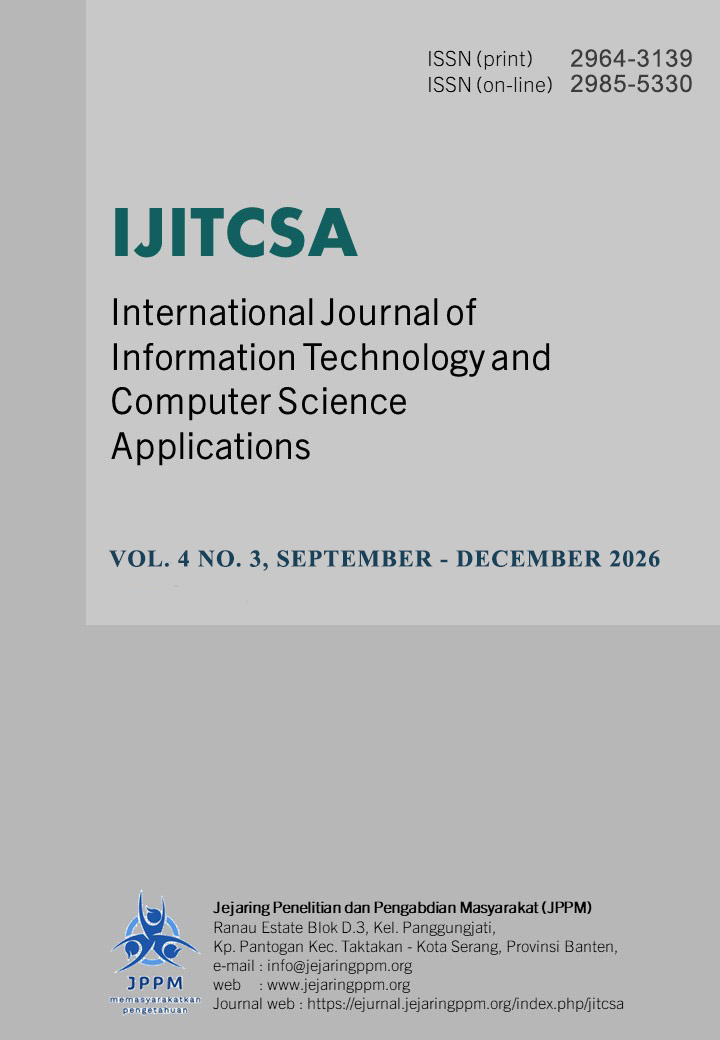
About the Journal
| ISSN Print (2964-3139) based on Decree Number 29643139/II.7.4/SK.ISSN/01/2023 dated January 18, 2023;
ISSN Online (2985-5330) based on Decree Number 29855330/II.7.4/SK.ISSN/02/2023 dated February 15, 2023 URL : https://ejurnal.jejaringppm.org/index.php/jitcsa The International Journal of Information Technology and Computer Science Applications (IJITCSA) is an information technology and computer science publication. Applications from both fields for solving real cases are also welcome. The JITCSA accepts research articles, systematic reviews, literature studies, and other relevant ones. The IJITCSA focuses on several fields of science, including information technology and the like and computer science fields such as artificial intelligence, data science, data mining, machine learning, deep learning, and the like. |
Current Issue
Editorial
Dear Readers,
We are pleased to present Volume 4, Number 2 of the International Journal of Information Technology and Computer Science Applications (IJITCSA), covering the May–August 2026 publication period.
This issue comprises ten research articles authored by researchers affiliated with institutions across six countries: Indonesia, Ghana, Türkiye, India, Pakistan, and Nigeria. This international representation reflects the journal’s continuing commitment to facilitating scholarly exchange and disseminating research from diverse academic and geographical contexts.
The articles published in this issue address a broad range of contemporary topics in information technology, computer science, data analytics, artificial intelligence, and computational modelling. Several contributions examine practical applications of data mining and machine learning, including customer preference clustering, stock-price forecasting, social-media sentiment analysis, sales prediction, and association-pattern discovery in production data.
This issue also includes studies that engage with emerging developments in advanced artificial intelligence. These contributions explore leakage-aware benchmarking of time-series foundation models, multimodal Earth-observation foundation models under missing and corrupted sensor conditions, geospatial vision-language models for spatial reasoning and temporal change understanding, and methodological frameworks for improving the reliability and generalizability of intelligent systems.
Environmental and geospatial intelligence also constitute an important focus of this issue. The published studies discuss physics-aware artificial intelligence for regional extreme-weather forecasting, multimodal remote-sensing applications, and hybrid neural–physics approaches to flood-relevant streamflow forecasting. These works demonstrate the expanding role of computational methods in addressing complex environmental, climatic, and hydrological challenges.
Across their different application domains, the articles share an emphasis on methodological rigor, reproducibility, robustness, and practical relevance. Several studies move beyond conventional performance comparisons by considering critical issues such as data leakage, domain shift, missing modalities, corrupted sensor observations, uncertainty estimation, cross-event evaluation, and cross-region or cross-basin generalization.
Collectively, the ten articles illustrate the continuing evolution of information technology and computer science research from isolated algorithmic experimentation toward more reliable, resilient, and application-oriented systems. We hope that the findings and perspectives presented in this issue will stimulate further research, encourage methodological improvement, and provide useful insights for researchers, practitioners, educators, students, and decision-makers.
On behalf of the editorial team, we extend our sincere appreciation to all authors from Indonesia, Ghana, Türkiye, India, Pakistan, and Nigeria for entrusting their research to IJITCSA. We also express our gratitude to the reviewers and editors whose careful evaluations and constructive recommendations helped maintain the academic quality of this issue.
Finally, we thank our readers and the wider academic community for their continued interest and support. We hope that the articles published in Volume 4, Number 2 will contribute meaningfully to the advancement and responsible application of information technology, computer science, data analytics, and artificial intelligence.